Our network and communities of practice connect public, private, and nonprofit leaders across the country to surface common challenges, learn from one another, and share what works — so progress can happen faster.
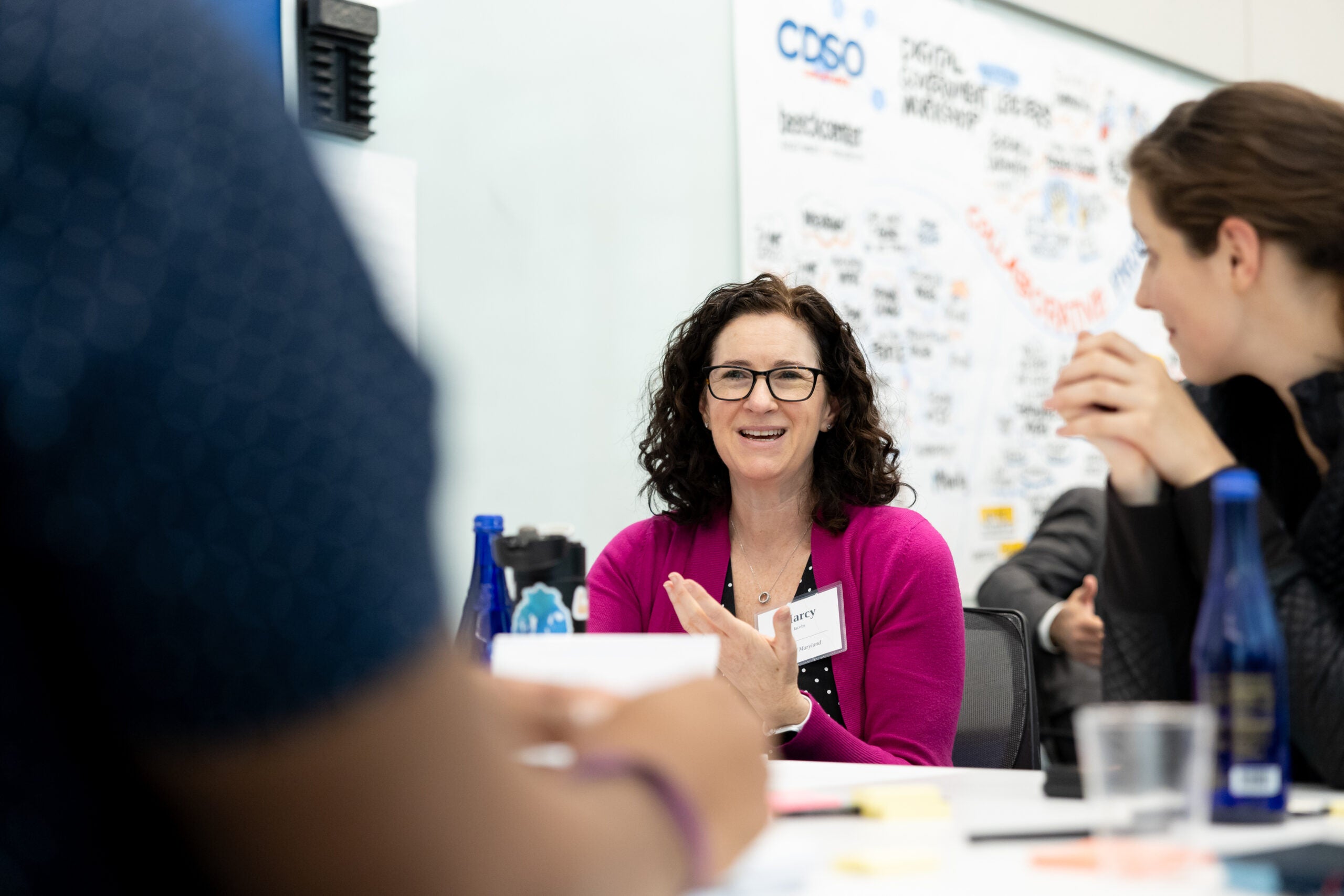
Marcy Jacobs speaks with fellow state leaders at a 2024 convening for Chief Digital Service Officers, a community of practice of the Beeck Center’s Digital Government Network. Photo by Jessica Latos for the Beeck Center for Social Impact + Innovation.
Building Government Services is a Team Sport
A national network helps public servants solve shared digital challenges across state lines.
One of the most memorable lessons Marcy Jacobs absorbed about designing government services did not come from a statehouse or federal office. It came from the command posts of the Federal Bureau of Investigation (FBI).
In the early 2000s, Jacobs worked alongside federal agents and local law enforcement officers in high-pressure command centers. Information had to land on the first pass, or it turned into dead weight. Nobody had time to reread or click links twice. People were making decisions under duress, sometimes with lives hanging in the balance.
Design that slowed them down failed them.
“Understanding the context [that] people receiving the information are living in matters,” Jacobs said. “We are designing for people at different moments of criticality, urgency, and emotion.”
When Jacobs described this period of her life, she smiled, recognizing a throughline in her career rather than a chapter left behind. She described the experience as “visceral” that revealed who she was building for and with.
“They don’t want to sit in a command post,” she said. “They want to be out on the street running down leads. How do we meet them where they are?”
Two decades later, Jacobs still designs for those moments. Only now, the people are millions of Maryland residents navigating public benefits and essential services — often between work shifts, child care pickups, and everything else life demands.
As deputy secretary and the state’s first chief digital experience officer, leading the Maryland Digital Service, Jacobs knows she cannot do this work alone. The problems are complex and interconnected: how to hire and retain digital talent, where to invest limited resources, and how to structure teams and design services that work under real-world constraints.
Jacobs is part of the Beeck Center’s Digital Government Network (DGN), a national network that brings together 8,000 public servants and civic technology partners grappling with the same challenges. The network unifies the Beeck Center’s Digital Benefits Network (DBN), Digital Service Network (DSN), and State Chief Data Officers Network (CDO), which merged in early 2026.
For Jacobs, knowing what has worked elsewhere and where peers are experimenting helps her make better decisions.
“Having people you can talk to, who are working on the same problems, matters,” Jacobs said. “It’s much harder to do this work on your own.”
• • •
The DGN engages practitioners through communities of practice and applied research. Across its topic- and role-based communities, 763 members — including nearly 500 state and local government practitioners — compare approaches, pressure-test ideas, and learn from one another’s successes and missteps.
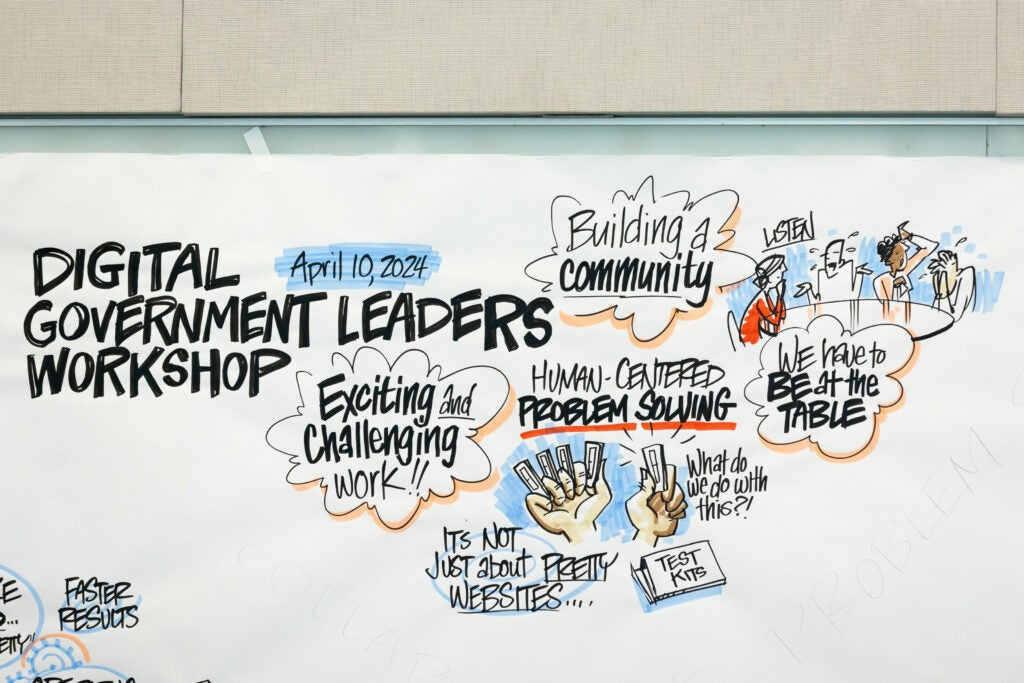
A visual summary poster captures key themes from the 2024 Chief Digital Service Officers Convening, including community building and human-centered problem solving. Photo by Jessica Latos for the Beeck Center for Social Impact + Innovation.
When Jacobs stepped into her role in the Old Line State, there was no blueprint waiting for her.
She inherited a small team of eight people responsible for building websites, provisioning Microsoft SharePoint sites, and overseeing major IT development projects. The mandate was broad.
So, she started the way she often does: by listening. She met with agency leaders to pinpoint what worked and what did not. She sat with her staff, asking what energized them and where they felt stuck. In the first two years, the team expanded to more than 55 people. But those early conversations set the tone for how the work moved forward.
That instinct to listen carried into another space.
Jacobs remembered joining her first Chief Digital Service Officer (CDSO) Community of Practice Zoom call and feeling “like the new kid,” she said. A dozen or so leaders were already on the line. Many knew one another.
She jumped in and asked peers: “What do you wish you had known when you started?” “What should leaders tackle first?” “What takes longer than you expect?”
“Having 30-plus like-minded people who are working on the same problems in different spaces gives a level of support that I didn’t have in the federal [government],” Jacobs said. “It felt very much like little pockets, because our organizations were all so different.”
It quickly became clear that Maryland’s challenges were common across state lines.
Her years of working in federal service, including in the Department of Veterans Affairs and the former U.S. Digital Service, taught Jacobs that no two agencies operate the same way. Many teams worked in silos. Missions and structures varied so widely that shared solutions rarely traveled across agencies.
However, at the state level, because many states deliver the same core services, she saw far more overlap.
One example is permitting and licensing.
“Permitting is not unique to Maryland,” Jacobs said. “Everybody has that problem.” And it is not one thing. “It’s recreational, occupational, business, environmental, [and] construction.”
States across the country are grappling with outdated permitting processes delaying critical infrastructure projects, raising costs, and creating uncertainty for families and businesses, according to a report from the Hutchins Center on Fiscal and Monetary Policy at the Brookings Institution. Slow and complex approval processes can stall projects across energy, transportation, and broadband, affecting how — and how quickly — essential services reach people. New transmission lines, for example, can take an average of 10 years to complete, The New York Times reported — longer than it took to build the Panama Canal and twice as long as the Hoover Dam. Fixing these delays requires coordination across agencies and states — work that is difficult to do alone.
When Maryland began exploring digital accessibility tools, Jacobs reached out to peers after a DGN meeting. Two states were already using a tool Maryland was considering and having good experiences. Maryland was still deciding how much scope to put into a contract.
That kind of peer exchange is becoming more urgent as states prepare for the April 2026 Department of Justice deadline requiring state and local governments to make web content and mobile applications accessible under Title II of the Americans with Disabilities Act. DGN members are looking for practical ways to prepare. A11yJam (Accessibility Jam) grew out of that demand, bringing government teams together to share practical approaches for making digital services accessible.
“The network and the collaboration have been the most valuable piece of this,” she said. “It’s helpful to hear from others to really understand the ground truth, not just what we get from a market research conversation — because somebody has thought about it,” Jacobs added.
• • •
Beeck Center researchers mapped that collective experience through rigorous landscape analyses, including “The State of State Digital Transformation,” which examines how states are organizing digital service teams, chief data officer roles, design systems, and related policies across all 50 states and U.S. territories.
Impressed by how practical the map was, Jacobs took in the landscape of who was doing what, and Maryland’s role within it. Patterns surfaced: States with chief data officers, for example, are 3.4 times more likely to have digital service teams.
“I thought the map was really cool,” she said. “I like being able to click on a topic and see what lights up. It helps you understand who’s doing what across the country.” Jacobs is already envisioning what would come next.
She pointed to the Beeck Center as the connective force behind it.
“Beeck is kind of magic,” she said. “They do the groundwork to pull us all together.”
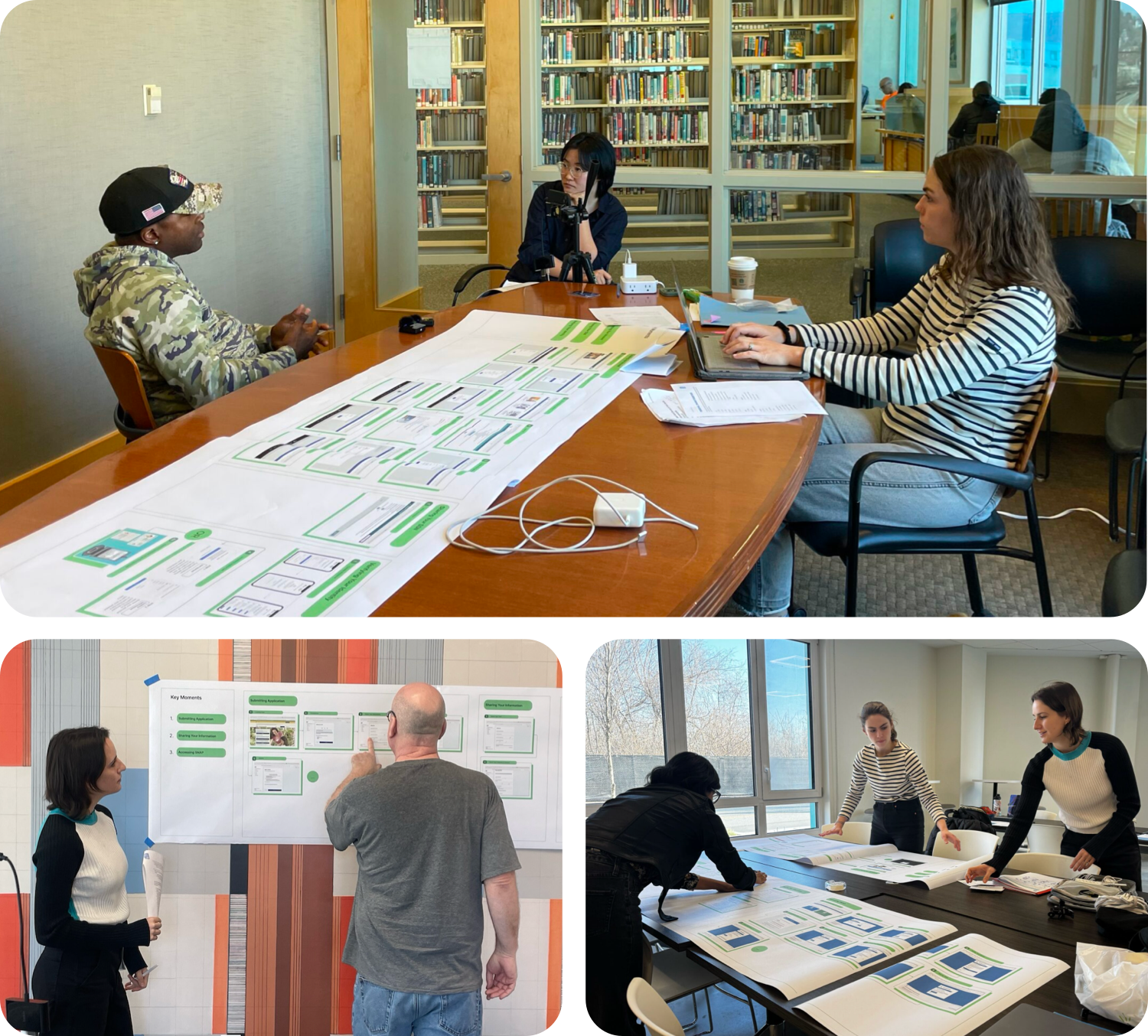
Digital Doorways to Public Benefits research examines how people navigate digital identity systems in public benefits programs. Researchers and community participants engage in interviews and human-centered design activities during the project, a partnership between the Beeck Center for Social Impact + Innovation and the Public Policy Lab. Photo courtesy of the Public Policy Lab.
A Place to Land
How connecting the right people moves research into action on public benefits access.
When Robert* walked into a meeting room at the Just A Start nonprofit in Boston on a chilly Monday morning in March 2025, he was an hour early and newly employed again.
Although he no longer needed unemployment benefits, he showed up anyway.
The room, lit by pale early spring light against its glass walls, was arranged for two kinds of work. At the center, a table and chairs for the interview. Off to the side, a second station: a physical collage displaying printed screenshots from Massachusetts’ benefits portal, arranged in a sequence — the application’s landing page, login page to the unemployment account setup, and the multi-step identity verification flow. A small camera stood ready to record. A note-taker hovered nearby, pen poised.
Robert — 61 years old and unpartnered, but with close ties to his extended family — did not consider himself relatively tech-savvy. After health issues left him unemployed for nearly a year, he spent weeks desperately trying to break through the unemployment system’s front door. Nights creating accounts. Resetting passwords, again and again. Verifying his identity.
He was looking for a job for months — and that morning, he landed one.
Even though Robert no longer needed help himself, he stayed to explain what it took to get through, so others would not get stuck. The research space made room for that.
• • •
The Beeck Center’s Digital Government Network (DGN) exists for moments like this: a national network that carves space for beneficiaries, state digital leaders, nonprofit partners, advocates, and researchers to share their experiences, surface shared questions and challenges, and shape what comes next.
Robert’s interview was part of “Digital Doorways to Public Benefits: Beneficiary Experiences with Digital Identity,” a Beeck Center research effort in Arizona, New York, and Massachusetts investigating how people navigate the digital systems that control access to public benefits including unemployment insurance, Supplemental Nutrition Assistance Program (SNAP), and Medicaid. The project connected state benefits agencies, community organizations, policymakers, and funders directly to the lived experiences of the people those systems are meant to serve. It focused on improving how people digitally access public benefits portals through account creation, authentication systems, and identity proofing.
In partnership with the Public Policy Lab (PPL), the research translated individual experiences like Robert’s into shared evidence states can act on through a series of insights and recommendations.
Jaime Stock, senior consultant at PPL, remembered that moment like it was yesterday.
“He was so ready to speak with us,” she said, her voice brightening through a Zoom call from her work office in New York. “No matter how much trouble somebody’s had, they’re always thinking about somebody who’s had a little bit more trouble than they have.”
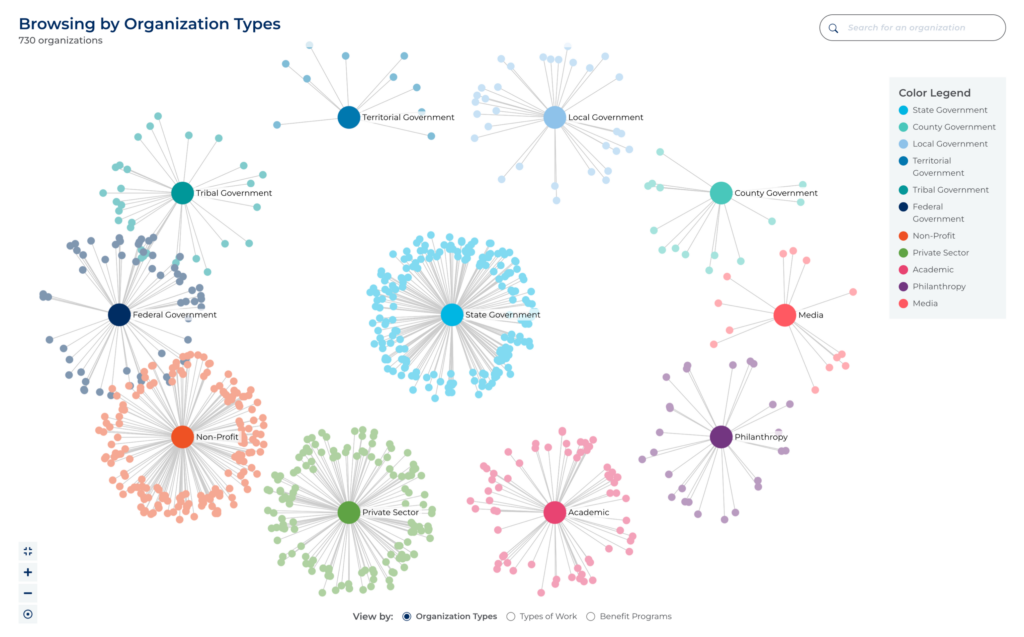
Within the DGN, the Digital Benefits Leadership Council (DBLC), a group of nonprofit leaders working on public benefits delivery, helps set direction by raising shared questions and coordinating actions across the civic technology landscape. Its work has led not only to research partnerships like Digital Doorways, but to a growing body of practical work: cross-sectoral convenings such as BenCamp, timely research and coordination on H.R. 1 impacts including “Implementing Benefits Eligibility + Enrollment Systems: State Responses to H.R. 1,” and tools like the Digital Benefits Ecosystem Directory and Map, which help practitioners see how their work connects to others’ work.
Digital Benefits Ecosystem Map showing 730 organizations grouped by type representing sectors like government, nonprofit, private sector, academic, philanthropy, and media, type of work, and benefit programs. Photo courtesy of the Beeck Center for Social Impact + Innovation.
The DGN heard concerns from its members that state government teams were struggling to understand how people actually experience digital identity systems inside benefits portals. For many, the barriers in creating accounts and proving people’s identity remained opaque.
To investigate, the Beeck Center launched the Digital Doorways research effort and partnered with PPL.
Beeck provided “the knowledge and expertise around digital benefits and identity management,” Stock said, including prior work documenting digital authentication and identity proofing requirements across online public benefits applications. PPL paired that technical expertise with qualitative, human-centered field research.
Digital identity was new territory for PPL, Stock said. The organization had long focused on how people navigate public benefits and where friction and barriers emerge.
“It ended up being really collaborative while we were in the field,” Stock said, without hesitation. “It was all hands on deck, and we were all learning from each other as we went.”
• • •
That spirit of bringing the right people in the room at the right moment shapes how Beeck convenes its network.
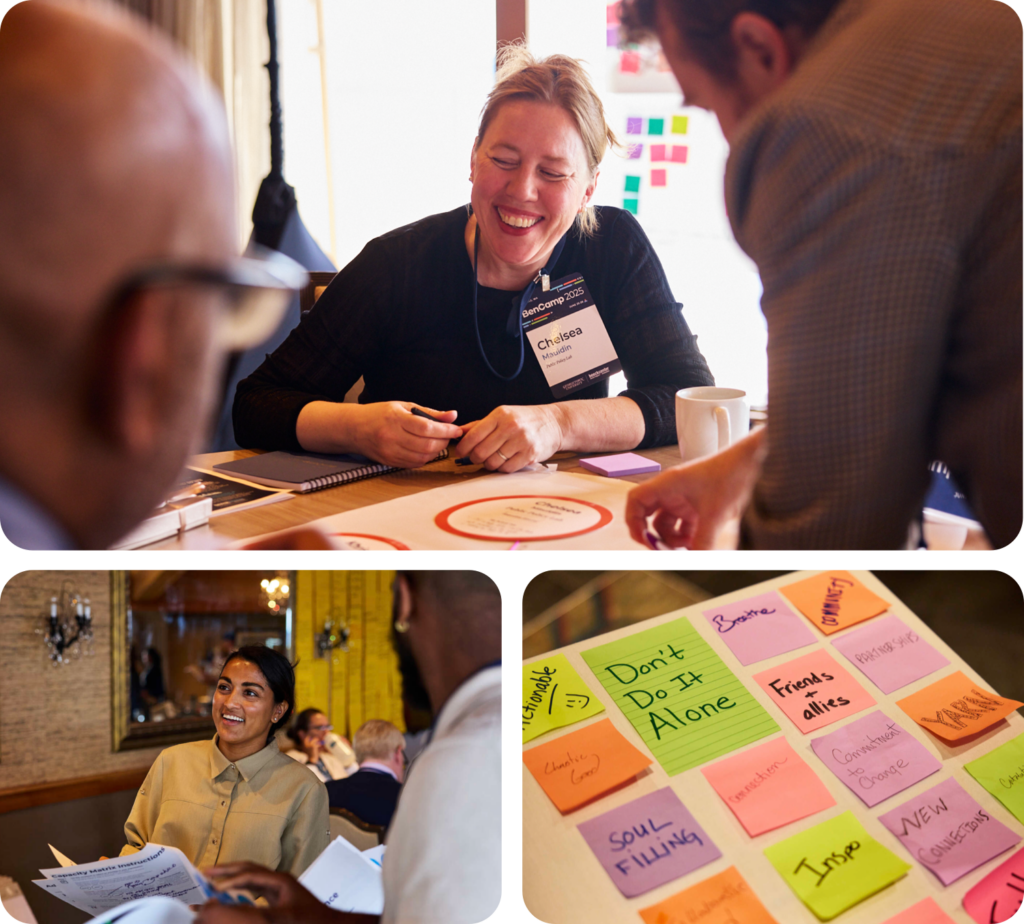
For Chelsea Mauldin, executive director of PPL and a member of the DBLC, that dynamic came into focus at BenCamp, a two-day convening hosted by the Beeck Center in June 2025 in Seattle, Washington. Nearly 60 digital services and benefits practitioners attended from state and local governments, nonprofits, academia, and philanthropy.
Participants gathered to share successes and challenges, compare state and local responses to federal changes, and map digital benefits access and service delivery capacity together in real time.
“What was nice is that they were all in one place at one time,” Mauldin said.
Chelsea Mauldin participates in a small-group discussion during BenCamp 2025 in Seattle, Washington, June 25–26, 2025. Bottom left: attendees review materials and share ideas during a breakout session focused on public benefits innovation. Bottom right: the BenCamp reflections of participants captured on colorful sticky notes. Photo by Matt Villanueva for the Beeck Center for Social Impact + Innovation.
Beyond convenience, she highlighted the shared credibility from being “selected to be part of a group of people who are all coming together to discuss these issues,” which mattered when subsequent partnership opportunities emerged on tight timeframes.
After BenCamp, PPL was looking for state government partners to join as partners a new proposal to the Center for Civic Futures’ Public Benefit Innovation Fund. Instead of starting from scratch, Mauldin already knew who to reach out to.
She contacted several states, but Oregon and New Mexico were the first to respond. After Mauldin met their leaders at BenCamp and built face-to-face rapport, the states provided letters of support and ultimately became pilot partners.
Without BenCamp, the process of finding state partners would have been much more challenging, Mauldin said. Cold emails would have taken weeks to reach the right leaders. Instead, PPL was able to reach out to state partners through personal relationships established within the legitimacy of a convened and coordinated group.
PPL secured the award, launching a new project with those states to improve how SNAP notices are written and delivered using AI tools. The goal is clearer language, so people understand what their state is asking and can access food without confusion or unnecessary administrative errors.
• • •
Back in Boston, Robert was still carrying the high of the job offer he received hours earlier.
“You guys are my lucky charm,” Stock remembered him saying, half-joking, half-serious.
He was back on his feet but remembered what it felt like not to be. He came to the interview room because someone once listened. Now, it was his turn.
* To protect their privacy, some individuals in this story are identified by a pseudonym.
Student Spotlight
Building Community
How one student analyst is rethinking leadership, technology, and the power of being people-first.
After years in the army as a data engineer, Walter Hall thought leadership meant having the answers. Then he started working with state chief data officers (CDOs) — people responsible for statewide data management, and increasingly AI — and heard something else entirely. The most effective leaders were not the most technical, they told him. They were the ones who knew how to connect people before systems broke down.
“They all say, ‘Try to be a good person and connection builder,’” Hall said.
This insight is meaningful to Hall’s work as a student analyst at the Beeck Center in two ways. First, it informed the content of the Beeck Center’s 2025 State Chief Data Officer Survey, a report in partnership with the National Association of State Chief Information Officers that details the evolving role of CDOs, the importance of effective data leadership, and common factors for success. Second, it shifted how Hall understood leadership — from strictly technical to problem-solving driven by community-building and collaboration.
“There are a lot of really smart people and a lot of really good resources out there,” Hall said, referring to his experience operating in the military. “But communication tends to be siloed to where you’re currently stationed. Beeck showed me… there’s multiple ways to make things happen.”
Many other government departments and agencies operate in these silos, unable to access information that would enable them to better serve their community because it is outside of their system. Not only do systems not speak to one another, but often government practitioners only interact with their own teams. The Beeck Center’s Digital Government Network (DGN) offers a different approach, connecting public servants from across agencies and governments to learn from one another, create solutions, build partnerships, and “ask safe questions,” according to Hall.
“[The DGN] is a place for like-minded people who have a like-minded mission to collaborate,” Hall said. “If they do it on their own, they’re going to just fail.”
The concept of a network and communities of practice — integral to the Beeck Center’s approach — was new for Hall when he became a student analyst in his first semester at Georgetown. Now, it’s a practice he hopes to bring back to the army after he graduates in May.
“The Beeck Center showed me you can be a people-first person,” he said. “You don’t need to be overly technical. You just have to understand the wavelength of [technology], and…give back by being a good person.”
“This network is absolutely crucial for our state’s successful journey on accessibility compliance resources, tips, and state design systems.”
Elena Talanker
North Carolina Department of Information Technology
 Elham Ali