Our research identifies and addresses the real problems that governments are facing today. We use evidence, lived experience, and emerging practice to give leaders the insights and tools they need to make better decisions and deliver results.
A wall displaying framed photographs of young parents and their children at Shine Together in Fresno, California. Photo by the Beeck Center for Social Impact + Innovation.
Family Health, by Design
How interconnected public systems shape the well-being of young families — and how they could work better.
At 5:30 a.m., before most of the East Bay hills wake, Luna* is already in motion.
She moves through her daily triangle of care in Northern California — traveling from her mother’s home to her father’s to her partner’s place — depending on whichever household can take care of her baby, so she can make it to class.
It is a self-taught choreography she knows by heart: getting her six-month-old ready, and preparing what she needs for class before dropping her off at her grandfather’s before heading to campus. From nine to three — and sometimes from seven to ten at night — she attends class, later checking in with her partner and deciding whether to return to her mother’s home or stay to co-parent. The rest of the day folds into childcare and homework. Outside of classes, the rhythm shifts to caregiving, stretching WIC benefits, planning meals, and making do with what she has.
By the time her classmates settle into their seats, Luna has already done the work of a small village.
• • •
More than three million college students in the United States are also parents, balancing schoolwork with child care and navigating public benefits such as the Women, Infants, and Children (WIC) program, the Supplemental Nutrition Assistance Program (SNAP), and Medicaid. These programs exist to support family health and stability, but they are not designed for everyone — especially not for families with complex caregiving and living arrangements.
New research from the Beeck Center’s Family Benefits Lab examined how public benefits and campus systems support family well-being. Conducted from June to October 2025, it included interviews and focus groups with 39 participants — young parents ages 13 to 24 and frontline staff from benefits agencies in California and community colleges and universities in Maryland.
Across both states, the research found that families do not experience education, health care, and food assistance as separate programs. They experience them as one web. When one strand breaks, families feel the strain immediately in their daily lives.
For Luna, that strain intensified when her baby turned six months old and her WIC benefits changed. Although baby formula and cereal were still covered, fruits and vegetables were not. Luna turned to CalFresh, California’s food assistance program, to bridge the gap.
Since she had a child, Luna said her case manager told her she would need to submit child support documentation.
The requirement ignored how her family actually lived. Luna and her partner co-parent peacefully and never filed for custody. Submitting paperwork had the potential to strain that relationship. Not submitting it could mean losing food support.
“I did consider that if it meant being on good terms with my partner, maybe I wouldn’t submit it,” she said during an in-person interview.
For young families like Luna’s, benefits rules not only determine access to groceries, they often fail to account for the lived realities of existing family relationships, health needs, and the fragile conditions families rely on to stay afloat. And for many, these benefits are not supplemental — as the name in SNAP suggests — they are the primary source of income for food and other basic necessities.
• • •
Across California and Maryland, young parents described public benefits not as a destination, but as a bridge — something to rely on briefly while staying enrolled in school, caring for their children, and moving toward independence.
“Many Californians who could benefit from public programs live in dynamic and changing environments,” said Sophia Chang, a former advisor on data exchange at the California Health and Human Services Agency. “It is hard [to] know when they become eligible for them and how the programs might work better together for clients.”
Chang said Beeck’s research arrived at a moment when state agencies were already looking for ways to deliver support more responsively and at the right time for families.
“One of the interests across all of the departments was we need to hear the consumer’s voice. We need to hear the voice of these women,” Chang said. When the Beeck Center began its research, she added, “We thought, ‘Wow, this is an opportunity to bring the interest of the agency and Beeck’s research interests together.’”
Families experience programs like Medi-Cal (California’s Medicaid program), CalFresh (the state’s SNAP program), and WIC as connected, Chang added — even when they’re governed and funded separately. By grounding those overlaps in lived experience and “the consumer’s voice,” the research provided agency leaders with evidence to shape policy decisions during pregnancy, birth, and early childhood — when family health outcomes are most critical.
“I think what the Beeck Center research has done is [give] an additional boost,” Chang said. “It’s given those champions a bit more oomph in their armamentarium to make the case.”
Roughly 30 percent of student parents rely on SNAP and many also depend on Medicaid. In California, coordination varies widely by place. In some communities, health clinics and nutrition programs are housed together. In others, they operate in isolation.
“Sometimes, they’re [other benefits organizations] down the hall,” Chang said. “Other times, they don’t even know who the CalFresh people are.”
California’s size adds another layer of complexity. Because health care and public benefits programs operate through different and vast systems and rules, even basic coordination — confirming eligibility or exchanging information about referrals to social services with consent — can be difficult. A pediatrician who wants to efficiently share information about parents and their children with WIC clinics, for example, may struggle to pass along that information. Families often end up repeating the same details across multiple portals and under different rules.
In California, that friction is compounded by how programs are administered locally. Each county runs its programs somewhat differently, Chang said, meaning families who move across county lines may have to start the process again.
For families already facing time poverty, this process adds time and mental labor to households already stretched thin.
Luna felt that burden firsthand.
“They do ask for a lot of information,” she said. “‘Upload your identity… everybody who’s in your household IDs.’ And then, when I talked to the social worker, she didn’t even ask for the identities of other people. It felt excessive.”
The Beeck Center’s research suggests that improving family health and well-being starts with practical design choices, including making families visible within systems that already exist.
When agencies share basic enrollment status, with consent, families could spend less time navigating paperwork and more time staying enrolled in school and caring for their children.
“Even confirming that someone is eligible and enrolled,” Chang said, “can make the state’s life easier, the program’s life easier, and the client’s life easier.”
Trust matters as much as efficiency. Young parents were more inclined to share personal information when the purpose was clear, the request was explained ahead of time, and when a trusted person — often a clinician or campus staff member — helped them understand why it mattered.
“I would be okay with the call,” Luna said, “especially if they mention, ‘Oh, we got your information from your health care [team].’ If they just come at me, it feels scammy.”
• • •
Improving connections between these systems can bring returns across generations.
“If we can get people the right services at the right time, we can avoid all kinds of higher-cost health care issues,” Chang said.
Access to SNAP is associated with improved health outcomes and lower long-term health care costs, according to data from the Center on Budget and Policy Priorities. Early access during pregnancy and early childhood improves birth outcomes and adult health years later.
Chang, however, said the stakes extend beyond health metrics. When systems are hard to navigate, she added, they can send a message that help is not meant for you — that the system is not built for, or may even work against you.
Luna knows that feeling. She also knows what she wants on the other side.
“I want to be self-reliant and independent,” she said. “And to get a job, so I don’t need these programs anymore.”
And perhaps, to reach a point where she no longer needs to ask.
*To protect their privacy, some individuals in this story are identified by a pseudonym.
A person uses a smartphone to interact with an AI assistant. Photo courtesy of Adobe Stock.
AI is the New Front Door to Government
People are asking GenAI about government services. If tools struggle to find official guidance, the internet fills in the gaps.
Last year, more than 20 million people were laid off. They received the same abrupt message: You don’t have a job anymore. For many, the next step was a nerve-wracking web search. “Can I get unemployment?” “What about groceries?” “Health insurance?” “Where do I go?” “What do I need to bring?”
For years, people looking for help online clicked their way to an official government page, checking source after source until something looked legitimate. That habit, however, is fading.
Today, many answers about unemployment, food assistance, health care, or taxes arrive as confident paragraphs from a generative AI assistant. Whether governments planned for it or not, tools like OpenAI’s ChatGPT, Google’s Gemini, and Anthropic’s Claude are becoming the front door to public services. Millions of Americans already use these tools weekly, often treating them as general-purpose advice engines.
But when official guidance is outdated, fragmented, or buried in formats machines can’t easily read, AI systems default to retrieving information that’s easiest to find. In an AI-first internet, the result can be a plausible answer that nudges someone in the wrong direction. That “small” nudge can be the difference between an accepted or rejected application, or meeting a deadline or missing it.
Even if government information is accurate, it needs to be published in the way people now look for it.
Over the last two decades, government websites evolved for humans clicking around. That produced familiar patterns: eligibility rules embedded in interactive calculators, policy guidance buried in PDFs, and dashboards that require clicking through multiple screens to reveal the next requirement.
For a person, that design is intuitive, if sometimes frustrating. For generative AI tools, the design can be functionally invisible. These tools summarize what they can access—and will tend to favor sources that are easy to extract and interpret.
With widespread use of AI assistants, governments need a new posture. Agencies shouldn’t publish solely for humans using browsers. They should also publish for the AI systems that pull, gather, and summarize information the moment a person asks a question.
If the official answer is not findable, a substitute answer will be. So, what should change? And who is responsible?
It starts with treating machine-accessible publishing as civic infrastructure. A few concrete steps will help governments get there: publishing program rules, eligibility guidance, required documents, and deadlines on stable web pages — ideally alongside PDFs and interactive tools, not inside them. It also means adding visible “last updated” lines or notes on “what’s changed” when new policies are put in place. This requires program teams who control the rules, digital teams who control publishing, and leaders who insist that official guidance is treated as mission-critical.
For governments that are already strapped, these tasks might feel burdensome. But the alternative is that public-facing policy becomes whatever an AI system can retrieve most easily — leading to missed deadlines, incorrect paperwork, and friction for people who can least afford it. If you have ever shown up with the wrong document, or missed a deadline you didn’t know existed, you know how these small errors turn into real delays. That, in turn, results in more calls to understaffed help lines or more back-and-forth with caseworkers — all costs that land on the agency, not just the applicant.
At the Beeck Center, we’re helping governments do this work in practical, repeatable ways. For example, in Marin County, California, we’re assessing how often AI assistants cite official county sources versus secondary sites. We plan to translate these findings into replicable guidance for other jurisdictions — and share it through the Beeck Center’s Digital Government Network, allowing governments to compare notes and avoid solving the same problem 50 different ways.
In an AI-first internet, governments cannot choose whether AI mediates public services — that’s already underway. But they can improve the odds that the tools people use surface — and cite — the official guidance.
Explore our research.
Student Spotlight
From Concept to Code
How a chance encounter led to an exploration of AI-powered coding in public benefits delivery.
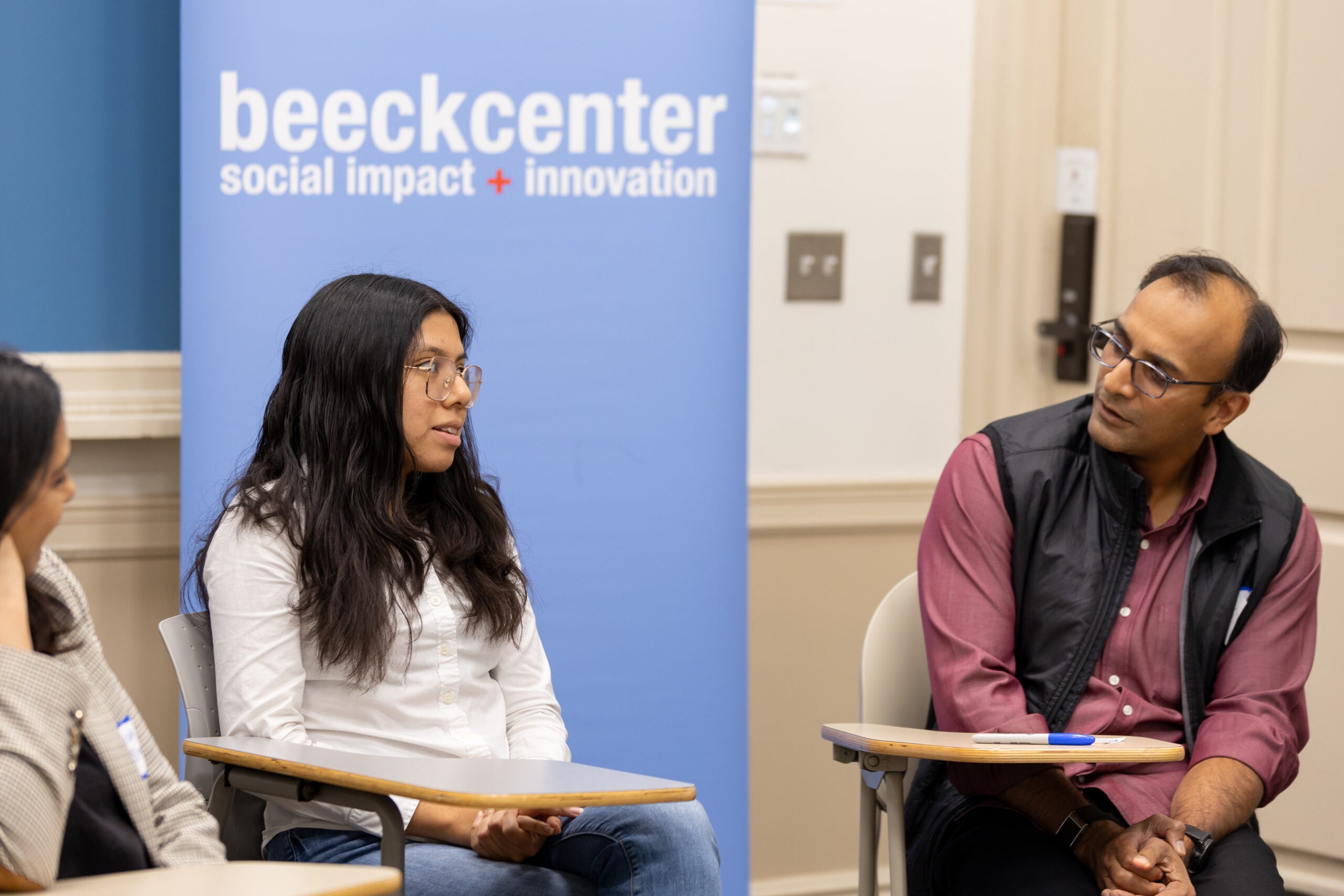
As the first in her family to attend university, Alessandra Garcia Guevara arrived at Georgetown from Germanna Community College with a goal of making the most of her two years on campus. During her very first class at Georgetown, she asked the student sitting next to her about their navy blue tote bag that read “the Beeck Center” in clear white text.
Now, as she prepares to graduate this spring, Garcia has spent more than a year supporting the Beeck Center’s research team.
Garcia had applied on her classmate’s recommendation to Beeck’s student analyst program, hoping to use her computer science major “for the public good.” She spent the next 17 months researching how artificial intelligence (AI) could improve the systems that help millions of people apply for and receive public benefits, using a process known as Rules as Code.
“[The Beeck Center] prepared me in terms of collaborative research and [taught] me how to develop research from an idea,” Garcia said.
With practitioners struggling to translate public benefit eligibility rules from lengthy policy documents into benefit delivery systems, AI can be used to write policy as software code — an approach that offers a way to standardize and expedite this process, and guard against errors that occur when rules are interpreted manually.
“If there’s a small mistake, then that costs somebody not being able to get food,” Garcia said.
As some of the first organizations to extensively research Rules as Code in the U.S. public benefits system, Garcia worked with an interdisciplinary team from the Beeck Center and the Massive Data Institute, running experiments and prototyping with large language models. After presenting early results to state leaders, technologists, advocates, and nonprofits at the Policy2Code Demo Day, the team published key findings and opportunities for further experimentation in March 2025.
“Coming from mostly a technical background into interdisciplinary research, where there was a lot of reading on public benefits, [this project] allowed me to grow in so many ways,” Garcia said. “I always felt like I was part of a team and not necessarily just the intern.”
More than enabling her to pursue research experience, the Beeck Center introduced Garcia to a new environment that connected her to mentors, a group of passionate peers, and opportunities to explore her interests and direct the course of her education.
“I’m a first-generation student, so being able to be in those rooms and … have supportive co-workers and supervisors … has really changed my perspective,” Garcia said, referring to her professional and personal growth. “The Beeck Center changed the trajectory of my life.”
It has been two years since the blue tote bag caught Garcia’s attention. But, when her research was published, she picked up her phone to call the classmate who started it all.
“I have found the research and learnings from the Beeck Center to be really helpful. It is such a good way to learn about what other government agencies are doing and realizing that our challenges and solutions are not so different.”
Joony Moon
Massachusetts Department of Transitional Assistance

 Elham Ali
 Andrew Merluzzi