Our training and technical assistance helps governments turn ideas into action. We help partners strengthen skills, navigate constraints, and develop tools and solutions that can be sustained over time.
Colorful adobe homes line a sunlit street in Tucson’s historic Barrio Viejo district. Photo courtesy of Adobe Stock.
“It Takes a Village”: Counted, Connected, and Cared For
Inside Arizona’s effort to link health and homelessness data.
At 15, she headed to a CVS store on Tucson’s east side with her friends to buy a pregnancy test. Back then, they traveled everywhere on foot. At that age, the unknown feels survivable when your friends are beside you.
Two weeks into her freshman year at Santa Rita High School, her test came back positive. Adria Tena bought prenatal vitamins and tucked them onto the nightstand beside her bed, underneath the ordinary clutter of a girlhood she hoped would cover for her.
Her mother found them anyway.
That was when Tena told her she was pregnant. And that was when her mother told her she could not live at home anymore.
That same night, Tena packed a backpack, grabbed a couple more totes with a few days’ worth of clothes and headed down her childhood street to a friend’s house. She never went back to get the rest of her things.
Fear barely registered. Instead, a resolve took hold that pointed her inner compass one way: forward, always forward.
“I didn’t necessarily feel scared,” Tena said. “I felt more like, ‘I’m gonna go and do my own thing and I don’t really need you.’”
What followed was a life bouncing around borrowed rooms in friends’ and family members’ homes. Someone always knew where to send her. Someone checked back. Someone filled a gap.
• • •
Years later, Tena still ensures one door leads to another. This time, she does it with the weight of Arizona’s public systems behind her.
As a program administrator at Solari, Inc., Tena oversees the Data Warehouse Enterprise for Linkage Arizona, or DWEL-AZ. It is a statewide effort to connect health and homelessness data, so agencies can better coordinate care for people experiencing homelessness.
The project took shape during the fourth cohort of Data Labs, an award-winning training and technical assistance program at the Beeck Center, in partnership with the National Governors Association, working directly with state government teams to scope and launch data sharing projects that improve public services. Through a human-centered design curriculum and hands-on support, Data Labs helped 18 state teams tackle policy challenges in areas like housing, education, workforce, and public benefits.
In the Grand Canyon State, health systems and homelessness systems often serve the same people, but rarely share data in ways that help them work together. The state’s Medicaid agency, the Arizona Health Care Cost Containment System, may not know a person’s housing status. Homelessness service providers may not have a clear picture of a client’s health or behavioral health.
DWEL-AZ bridges that divide — linking records across Arizona’s Medicaid agency, Department of Housing, and homeless service providers, with privacy and security protections in place — so providers and policymakers can prioritize services, coordinate care, and understand needs at a system level.
• • •
The work has taken on urgency in recent years. In 2023, Arizona Governor Katie Hobbs issued an executive order revamping the state’s homelessness commission and calling for stronger coordination across agencies. At the same time, housing insecurity has increased substantially since the COVID-19 pandemic, according to the Arizona Center for Economic Progress.
Partnering with the Beeck Center, however, helped the Arizona team name what they were already experiencing: fragmented data that was making a growing crisis harder to address.
“The hardest part isn’t agreeing on the problem,” said Travis Done, a senior consultant in the State Data and Analytics Office at the Arizona Department of Administration. “It’s aligning consent, compliance, and trust across organizations that were never designed to work together,” Done said. Solving it required “stitching” across programs and institutions, he said.
That challenge — alignment across systems — was one Tena personally understood.
As a teenager, she attended Tucson’s Teenage Parent High School and graduated valedictorian. She went on to Pima Community College with multiple scholarships. But she is quick to say none of it happened alone.
At 17, a youth program helped cover her apartment security deposit. Youth On Their Own linked her to mentorship and housing navigation. School staff and community organizations made referrals, filled gaps, and followed up. Each step depended on someone identifying and connecting her to resources.
“I used to think I had to do everything myself,” Tena said. “I was determined. I felt like I had something to prove.” Over time, that mindset shifted. “Now my motto is, “It takes a village.’”
Since completing Data Labs, DWEL-AZ’s pilot has run for more than a year. The project’s team built governance structures and collaboration across the state’s Medicaid agency, its three Continuums of Care, and homelessness service providers. The pace has been slower than expected, but progress is steadily moving forward.
“What we didn’t fully anticipate was how much time governance would take,” Tena said.
Sharing data across health and homelessness systems requires navigating consent rules that vary by region, strict Medicaid compliance requirements, and privacy protections designed to prevent harm. For Medicaid, this meant developing exclusionary checklists, so providers do not inadvertently commit fraud. For homelessness providers, it meant new agreements, new workflows, and new assurances about how client data could — and could not — be used.
“All that had to be built before anything could go live,” Tena said. “The security, the policy review, the governance. It’s the kind of work that’s invisible, but it’s also the work that makes this viable.”
This alignment demanded time, especially for a project funded largely through philanthropy. Without dedicated state line items, many partners contributed to DWEL-AZ on top of their day jobs. The benefit, Tena said, was deeper buy-in and shared ownership.
After the team presented to funders during Data Labs’ Demo Day, they secured $330,000 in new funding from the Garcia Family Foundation, Tena said. The support provided runway to complete governance work funders recognized as essential.
• • •
For Done, sustained funding mattered less for speed than for durability. “If you don’t build the foundation right,” he said, “the system won’t last.”
DWEL-AZ is now within about 90 days of launch, Tena said. That milestone reflected not only resources or timing, but the process that helped the team get there. Data Labs mattered in part because the Arizona team arrived from different places. Done worked across agencies without formal authority over most of the people in the room. Tena was newly hired, managing day-to-day operations without a data background. Randy Hade, Solari’s director of homeless initiatives, brought years of experience convening homelessness coalitions but little time to rethink how those groups worked together.
Most cross-sector collaborations, Done said, are relationship-driven and time-starved. People solve urgent problems in real time, with little opportunity to step back and design a shared plan end-to-end. Beeck’s technical assistance created that space.
“It gave us a way to work toward common ends,” he said. “I’ve never seen such varied folks working together like that. It’s inspiring.”
Today, DWEL-AZ has its own implementation-focused working groups, reflecting what the team carried from Data Labs. This means approaching problems from policy, technical, human, and operational perspectives at the same time; using shared language to explain DWEL-AZ to new partners; and trusting that progress can happen even without formal authority.
Coming from a behavioral health background, Tena was still learning the terrain as the first full-time staff member dedicated to administering DWEL-AZ.
“There were areas I wouldn’t have thought about on my own,” she said, including how to sequence data work over time, plan for governance milestones, and translate big ideas into manageable steps.
The tools introduced during Data Labs are still in use, including action plans, opportunity trees, and goal-setting frameworks. Tena now applies them to DWEL-AZ and across Solari’s analytics workgroups. “It helped me think forward in a way I didn’t before,” she said.
Hade described the outcome in terms of focus: “It helped us tighten our goals. We had a lot of loose, ambitious ideas,” he said. Data Labs pushed him to look at the project from multiple angles. The process, he added, helped newcomers like him and Tena feel more confident about what they were trying to achieve, and hone ideas into clear objectives they still use to guide how they talk about DWEL-AZ.
For Tena, that clarity connects back to why she entered social work in the first place.
“When people know what they’re eligible for, when systems talk to each other, that’s power,” she said. “Knowledge is power. And connection is how people get to the next step.”
The historic Capitol Theatre in downtown Macon, Georgia. Photo courtesy of Adobe Stock.
Centering Community in Digital Government
How Macon-Bibb County, Georgia is revitalizing neighborhoods through digital design.
When Erin Keller thinks of downtown Macon, Georgia, she does not first picture the bustling main street she helped to revitalize, leaders cutting ribbons in front of new businesses, or visitors enjoying live music in the streets. What she pictures first is her community before dawn.
It is in those dark hours, with windows shuttered and doors locked, that Keller finds an integral part of Macon-Bibb County’s recent development success. She thinks of Hospitality Ambassadors: residents who wash graffiti from business walls and clear trash from sidewalk curbs before the sun rises. “[These are] incredible people who take pride in doing all the unsavory things,” she said. What Keller sees is her whole community, and she knew she had to help her government see that too.
Over two years, Keller served as a liaison between local government and the local business community for The Opportunity Project for Cities (TOPC), a Beeck Center technical assistance program that operated in seven municipalities nationwide in partnership with the Centre for Public Impact and Google.org. As Chief of Staff and Vice President for Development at NewTown Macon — a nonprofit overseeing the county’s business improvement district — Keller worked with government partners to advance digital solutions through community engagement, interviews, focus groups, and user testing.
As a community leader, partnering with the Beeck Center changed Keller’s relationship with county government — from merely working onthe same issues to working with one another toward a common goal.
“[The county government] never knew who the end user actually was, so they were trying to solve problems with very little knowledge,” she said. “[Beeck’s technical assistance] really helped [the county government understand] … the true pain points and obstacles that [community members] were facing.”
• • •
In Macon-Bibb, the Beeck Center brought community members, government, and technologists together to address two local challenges. The first was blight, which is often associated with local disinvestment, population loss, and economic decline. This community priority had gone largely unaddressed in Macon-Bibb, leaving more than a quarter of properties vacant countywide and creating significant public safety and economic concerns. With the Beeck Center’s support, Macon-Bibb designed an application for community members to report the location of blighted and abandoned properties to their government, improving its ability to effectively track and respond to blight.
Two years later, Macon-Bibb partnered with the Beeck Center again to address business permitting, a known challenge for many small and local business owners nationwide. With the Beeck Center’s help, Macon-Bibb developed a centralized portal to streamline the county’s business permitting process, which had previously been fragmented across multiple agencies and websites, presenting a burden for business owners, inefficiencies for county staff, and affecting local economic development.
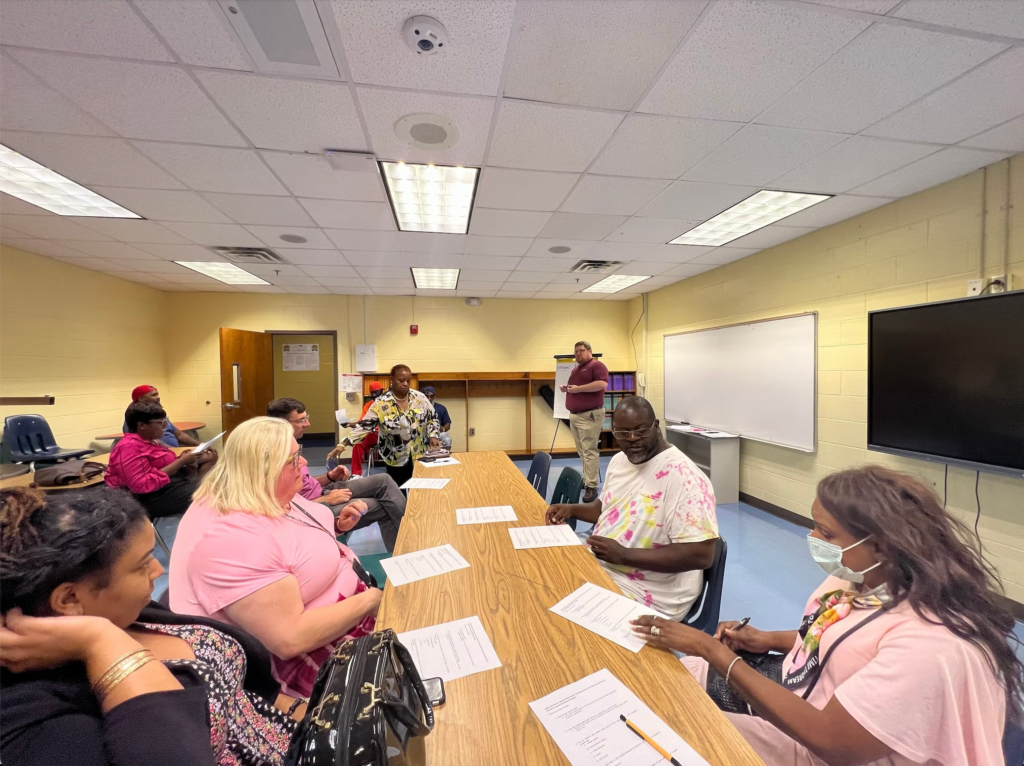
Barbara Marlin (left) engages with residents of Macon-Bibb County during a Beeck-led activity — one of many concept testing and focus group discussions that helped shape community-led solutions to reduce blight. Photo courtesy of Macon-Bibb County.
While these digital tools and prototypes were one key result of Beeck’s support, a broader, system-level outcome was a change in practitioners’ skills and thinking.
“[Before partnering with the Beeck Center], we didn’t have a good feel [of the community],” said Barbara Marlin, GIS manager in Macon-Bibb’s IT department. “TOPC really paved the way for us to look at citizen engagement as a driving force, [rather] than an afterthought.”
This reflects the Beeck Center’s central approach of applying human-centered design (HCD) principles to ensure that digital tools and solutions align with the needs and experiences of their intended users. Whether an AI-enabled search feature on a government website or an interactive map, a tool cannot succeed if residents can’t understand or navigate it due to accessibility issues, digital literacy gaps, or limited internet connectivity. Without a pulse on community experiences, well-intentioned tools can fail.
This is what brought Marlin to a holiday event at a community center in December 2022 to unveil an early prototype of the blight-reporting tool. Community members, many older residents, had come to test the county’s proposed solution to a problem that affected them all. Many, however, struggled to use it.
“There were teaching moments in there that were really instructional, not just [to community members], but to us,” Marlin said. “It made me look differently at how our digital solutions … may — or may not be — useful.”
• • •
After these insights, Macon-Bibb government technologists returned to designing and prototyping, eventually releasing a blight reporting tool recognized with a $750,000 grant this year to revitalize the county’s public spaces.
Marlin’s experience with the Beeck Center is not unique. TOPC participants nationwide reported a significant increase in usinghuman-centered design in their strategies, programs, and partnerships, with some uses more than doubling after the program. In 2025, practitioners continued to put those lessons into practice.
Marlin spoke about the county’s latest project, a new website content management system improving both internal organization and user experience. Before the Beeck partnership, only a general feedback form lacking project-specific details would be available to the public, “buried at the bottom of the webpage,” according to Marlin. Now, Marlin’s team has been employing human-centered design principles and community engagement from the outset, and looking at user feedback for the website “proactively, instead of reactively,” she said.
“[Macon-Bibb is] really striving to be a data-driven community that responds to its constituency,” Marlin said.
The county continues to root its work in seeing its whole community — from residents who show up to test a new application to those rising before dawn to keep downtown running.
Student Spotlight
Policy in Practice
Inside a student analyst’s experience working hand-in-hand with government practitioners.
In her political economy classes, Sandhya Soundararajan used models and equations to understand government. On her first day working with Hennepin County, Minnesota, she encountered a new side of government: a tight deadline, a legal risk, and no clear roadmap.
“They were so excited to work with me,” she said. “And I was excited too. I just had no idea what we were going to do.”
With an April 2026 deadline approaching to implement new digital accessibility requirements, Hennepin County tasked Soundararajan to create a monitoring system to ensure government websites were up to standard. For three months, she worked alongside the Digital Accessibility and User Experience departments to improve digital delivery for the most populous county in Minnesota — an experience enabled by the Beeck Center’s student analyst program.
“At Beeck, I’m able to take a more hands-on approach,” Soundararajan said. “I don’t know any other place, at least on campus or even in D.C., that would give students the flexibility to take over a project and run it on their own.”
It is rare for students like Soundararajan to encounter these issues in a political economy textbook. On paper, governments have been required for more than 30 years to ensure their digital platforms are accessible; many users likely never consider how their experience on a government website would be impacted if they could not use a keyboard or see the page.
However, in Hennepin County, Soundararajan saw what her textbooks had missed about government — that even though federal standards have existed since the 1990s, local practitioners still work daily to keep platforms accessible. These public servants are the force behind stopping a design issue from becoming a forgotten small business application, undelivered food assistance, or lost lifesaving health care.
“In my classes, we put a lot of focus on the elected officials and their policy objectives,” Soundararajan said. “But we forget that there are hundreds of people working under them, who are actually creating solutions for constituents.”
When she returned to the classroom after her student analyst experience in Hennepin, Soundararajan had gained an understanding of government in practice — not merely in theory. By setting aside her textbooks and models, she not only saw the real way government operates firsthand, but also contributed to it.
“The expertise was indispensable in understanding our own blind spots; they enabled us to break outside our own tunnel vision. Without the Beeck and Georgetown reputations, the project [wouldn’t have] the necessary credibility to accomplish its task.”
Curt Clemons Mosby
Illinois Governor’s Office of Management and Budget


 Elham Ali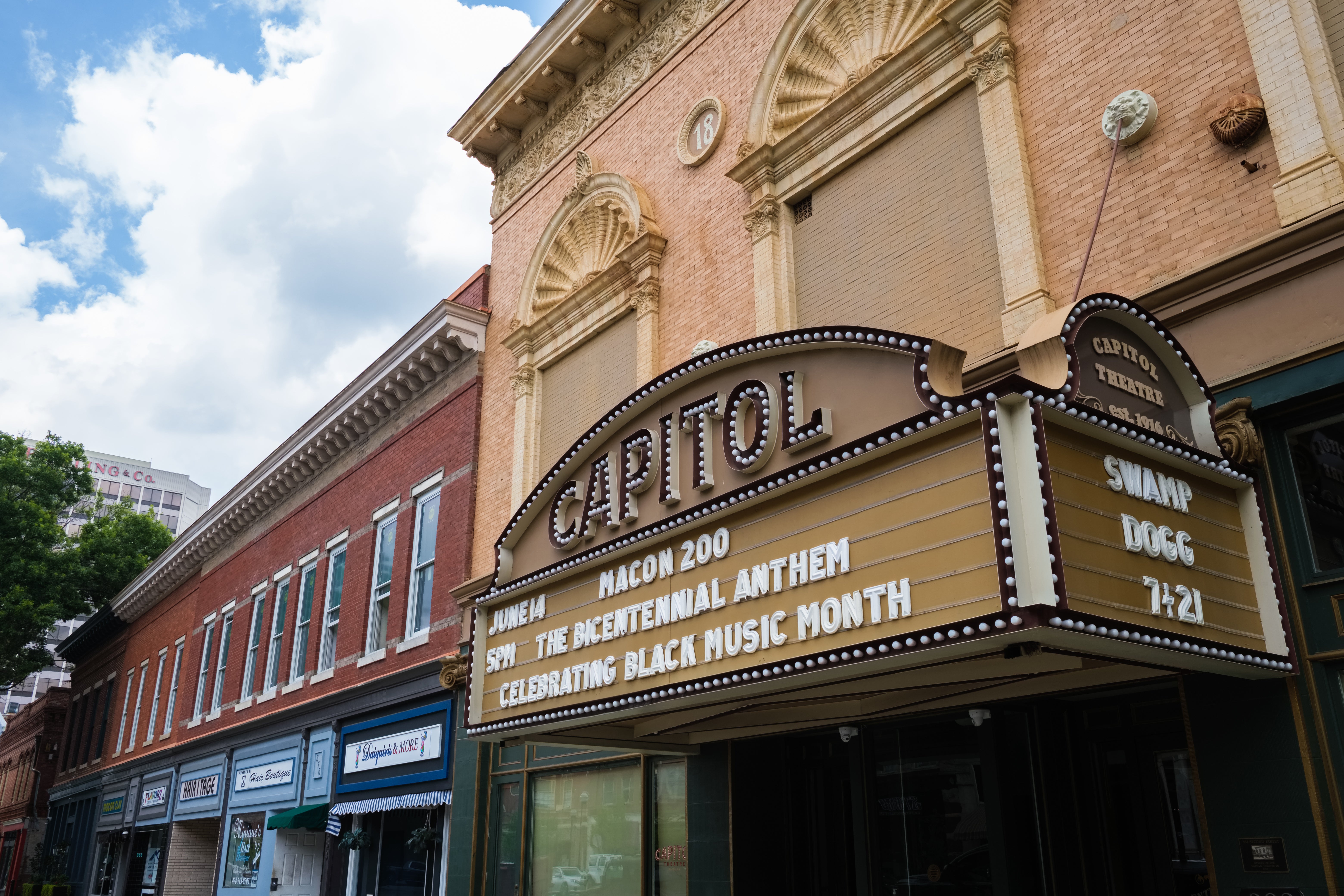
 Anna Opalsky