When “Household” Doesn’t Match Real Life: Why Complex Living Arrangements Make It Hard for Young Mothers to Access Benefits
This piece draws from a qualitative research study conducted by the Beeck Center’s Family Benefits Lab in California in 2025, which included in-depth interviews with 12 young mothers and 12 staff members from frontline benefits and community-based organizations. The study explored how lived experience shapes access to public benefits programs like Medi-Cal and CalFresh, from privacy concerns to data consent. This piece highlights one recurring theme from that research: the challenge household complexity presents for young mothers accessing benefits.

The Gap Between Policy and Reality
Many young mothers live in dynamic arrangements, moving between their parents’ homes, partners’ families, or other shared caregiving situations. Yet public benefits applications typically include specific, rigid definitions of a “household.” Mothers often do not have clear guidance on how to describe their realities, or how to advocate for themselves when definitions do not easily fit. As a result, their families may face confusion, delays, and potentially avoidable errors, or give up on applying entirely, while states can face higher administrative burdens when reviewing their applications.
Access to benefits such as Medicaid and the Supplemental Nutrition Assistance Program (SNAP), known as Medi-Cal and CalFresh in California, is linked to improved maternal health, infant outcomes, and child development. Most maternal mortality incidents occur in the postpartum period, and any disruptions to health coverage or nutrition assistance during this window can have lasting consequences for both mothers and their children. Administrative complexity and churn can reduce take-up of eligible benefits, particularly for families experiencing transitions.
At the same time, new federal policies, such as recent changes to benefits program work requirements, are adding a layer of complexity to manage for states and families. A caretaking exemption under these new policies presents an opportunity to incorporate lived experiences earlier on in the process. There’s already bipartisan support for this type of approach, as demonstrated by a recent Centers for Medicare & Medicaid Services (CMS) guidance requiring states to create Beneficiary Advisory Councils that include Medicaid beneficiaries, families, and caregivers.
What We Heard From Young Mothers in California
The Family Benefits Lab spoke with 12 young mothers, many between ages 18 and 22, with the majority giving birth to their first child at 22 or younger. To better understand the full service journey of these mothers as they connected to programs in California like Medi-Cal, CalFresh, and the Special Supplemental Nutrition Program for Women, Infants, and Children (WIC), we also interviewed 12 benefits or program staff who served these mothers.
Our hypothesis was that helping young mothers successfully access programs early in their parenting journey would ultimately pay dividends for long-term family health, well-being, and economic stability.
A key insight from our work was that mothers often do not think of their “household” the way benefit programs describe them. They are also often undergoing important life transitions, such as moving in or out with a partner or moving out of a parent’s home.
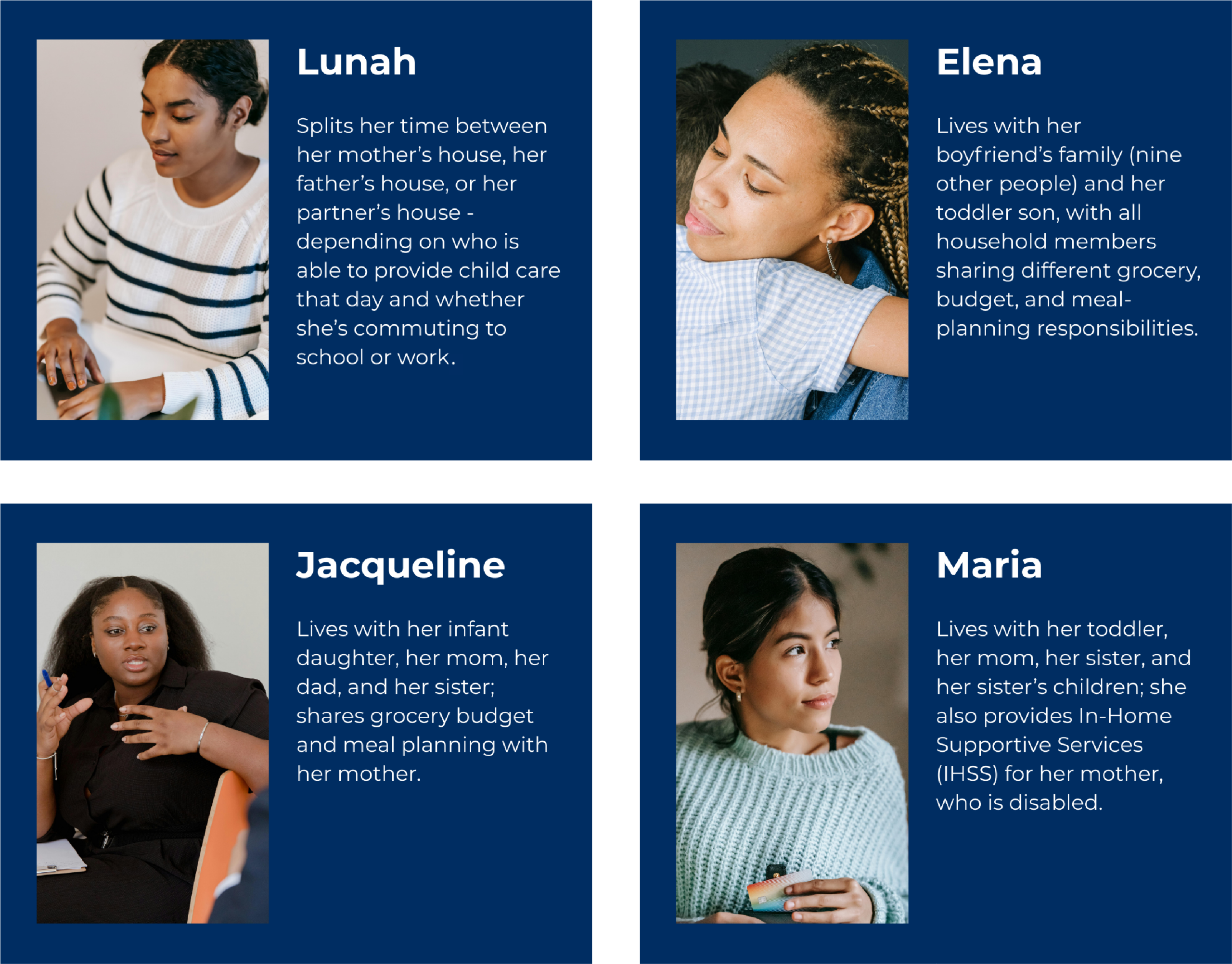
Some patterns in the living arrangements of our participants included:
- Living with parents while caring for their children
- Living with a partner’s extended family
- Moving between households for child care, convenience to school or work, or housing stability
- Living in multi-generational households with shared caregiving but separate finances and household responsibilities
One participant shared:
“I feel like they [the government] should go off of your income and baby’s income, not the people you live with… I couldn’t get food stamps just because my parents and sister made more.”
Mothers described confusion about whose income “counts” and stress about answering incorrectly. Some told us that they felt more assured when visiting benefits offices in person to resolve ambiguity face-to-face, because they were concerned that online applications might not accommodate nuance, even though these visits were often inconvenient and time-consuming.
How Public Benefits Programs Define “Household”
For most parents and children, Medi-Cal uses Modified Adjusted Gross Income (MAGI) rules. Household composition is based largely on tax relationships, not actual living arrangements, under federal regulation (42 CFR §435.603). This is difficult for young mothers who may still be claimed as dependents, live in a parent’s home without financial support, or rely on informal caregiving invisible to tax rules. SNAP generally defines a household as people who live together and purchase and prepare food together, and certain people must be in the same household even if they don’t purchase and prepare food together, including a person under 22 who is living with his or her natural or adoptive parents or step parents. (7 CFR §273.1).
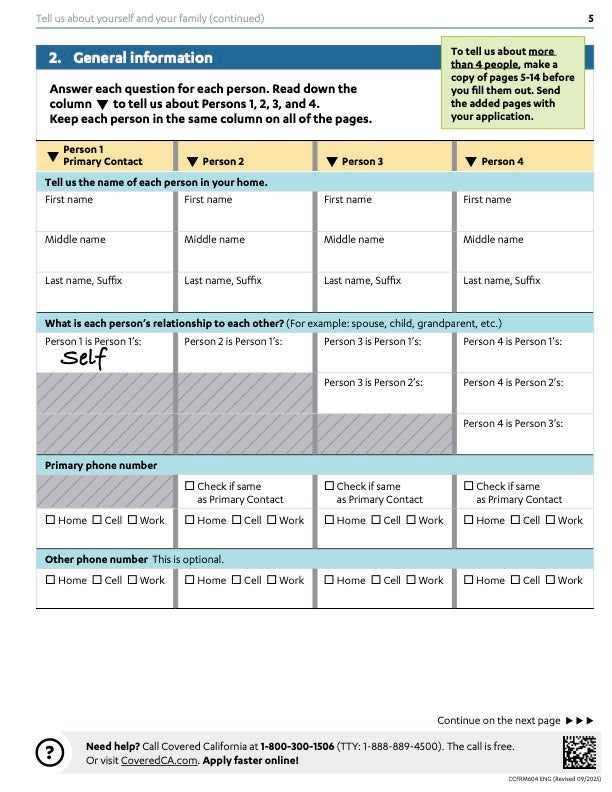
In practice, this can become confusing when extended families (or roommates) share kitchens but not budgets, or when food purchasing is informal or inconsistent among those living together. A young mother may be part of a parent’s tax household for Medi-Cal, but not share food costs for CalFresh, or vice versa. It is difficult for applications to describe these distinctions in plain language, and mothers may be denied benefits due to the income of others, whose resources they do not actually access.
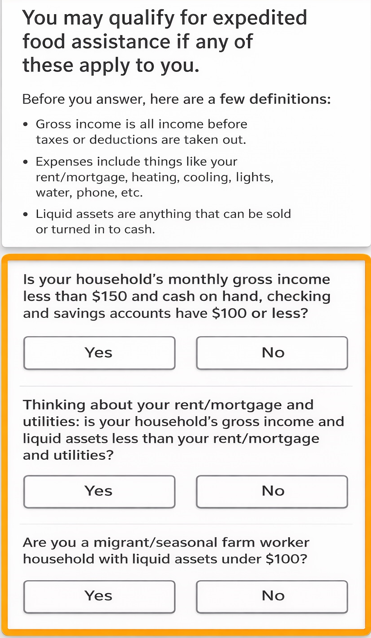
When applications do not reflect real household complexity, families may make unintentional mistakes. This then leads to managing additional questions or verification requests, which lengthens the overall time to receiving their benefits. Some mothers may give up on their applications altogether—a missed opportunity for their families.
States, in turn, could face higher administrative costs and increased SNAP error-rate risks. Higher rates can trigger federal penalties (7 U.S.C. §2025(c) and 7 CFR Part 275) that affect cost-sharing between states and the federal government. States have strong incentives right now to reduce error rates to ensure the survival of these programs, and this could have a disproportionate impact on families with complex living arrangements. The unintended consequence is that those most in need may face the highest barriers to receiving health and economic support.
Recommendation: Scenario-Based Guidance for Complex Households
Young mothers told us they need clear, non-judgmental guidance grounded in real scenarios:
- “If I live with my parents, but buy my own groceries, what do I report?”
- “If I stay with my partner some nights, does that count as a household?”
- “If a parent helps with rent sometimes, does their income count as mine?”
States could develop plain-language, scenario-based explanations of benefits program household rules tied to common arrangements and life transitions, such as a change to household composition or a move to a new household. Clearer guidance, especially for multi-generational households, could improve application accuracy, reduce churn, and lower administrative burden, while supporting the health of moms and their children.
States could also explore privacy-protective, AI-enabled tools embedded in trusted benefits platforms like BenefitsCal in California. Families could describe their specific situations in plain language, and the AI-based tool could translate those inputs into program-specific guidance, referring users to optional human follow-up if needed.
Conclusion
Families’ lives are complex, and benefits systems should be designed to accommodate that complexity. Incorporating lived experiences into guidance and service design is not only good policy, but essential to aligning program intent with the reality of families.
For more information on the Family Benefits Lab’s work, please contact the team at fblbeeck@georgetown.edu.
Acknowledgements
Annie E. Casey Foundation*; Ballmer Group.
Thank you to Dottie Rosenbaum (Center on Budget and Policy Priorities), Elisabeth Wright Burak and Leo Cuello (Georgetown Center for Children and Families) for contributing insights to this report.
*This research was funded in part by the Annie E. Casey Foundation. The findings and conclusions presented in this publication are those of the authors and do not necessarily reflect the opinions of the Foundation.